Source of bundled assets the interpreter draws from for from/copy.
More...
#include <interpreter.h>
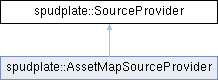
Classes | |
| struct | Entry |
One entry returned by list_under. More... | |
Public Member Functions | |
| virtual std::pair< std::vector< std::uint8_t >, std::uint16_t > | read (std::string_view path) const =0 |
| Read the bytes of an asset by its normalised path. | |
| virtual std::vector< Entry > | list_under (std::string_view prefix) const =0 |
| List every entry under the given prefix, including synthesised intermediate directories. | |
Detailed Description
Source of bundled assets the interpreter draws from for from/copy.
Two concrete implementations live in src/interpreter.cpp: a disk-backed provider (cwd-relative reads, used when no asset map is supplied) and an asset-map provider (used when running an installed .spp).
Asset paths are bundle-root-relative and pre-normalised by spudplate::normalize_asset_path (forward-slash, no leading /, no . or .. segments, no embedded NUL). A trailing / on a returned Entry path means "empty leaf directory".
mode == 0 is the documented "no mode information" sentinel - the disk-backed provider always reports zero so callers preserve the pre-existing nullopt-mode behaviour of bare-.spud runs.
Member Function Documentation
◆ read()
|
pure virtual |
Read the bytes of an asset by its normalised path.
Returns the content and the asset mode (or 0 when the provider does not carry mode information).
Implemented in spudplate::AssetMapSourceProvider.
◆ list_under()
|
pure virtual |
List every entry under the given prefix, including synthesised intermediate directories.
The returned list is in pre-order (parent before children) so callers that map entries to filesystem operations naturally satisfy the create-parent-first ordering.
Implemented in spudplate::AssetMapSourceProvider.